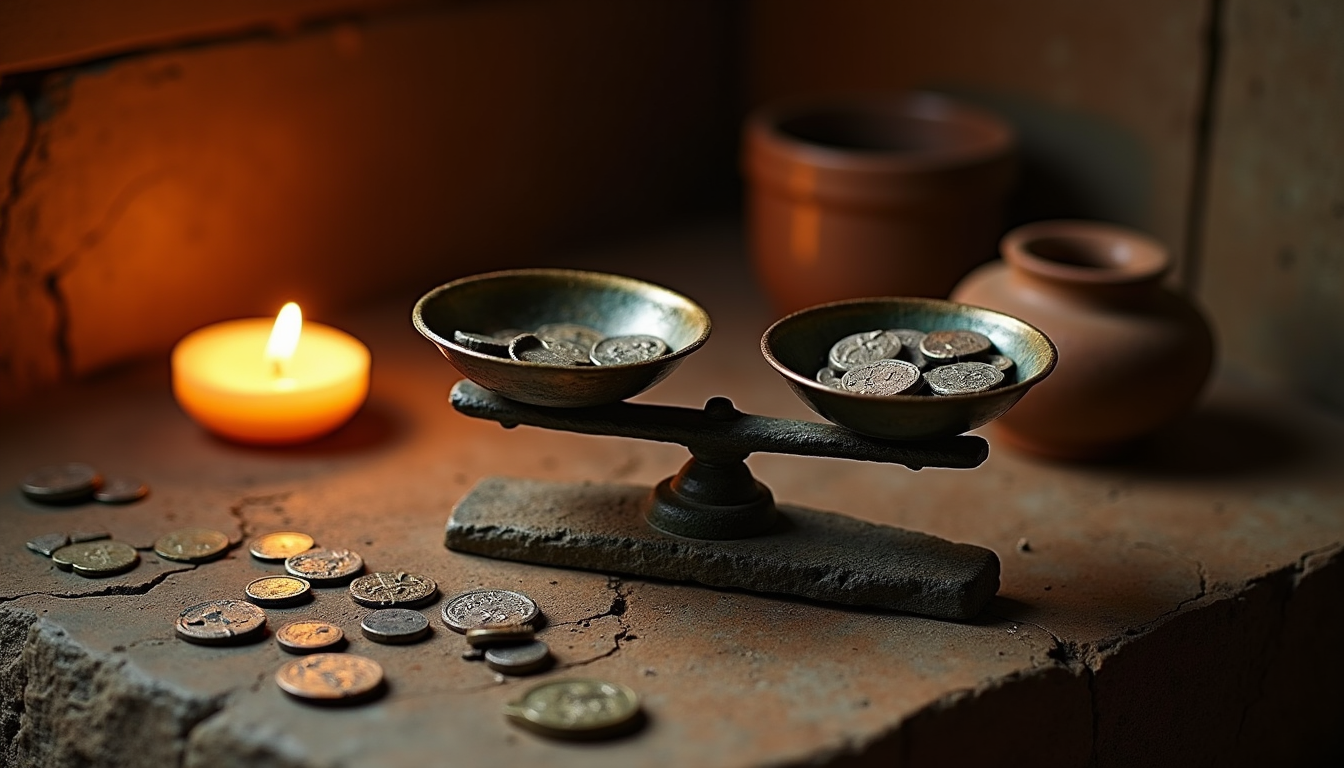
Biblical weights, measures, and money were never standardized — and getting the scale right is often the whole theological point. A working reference table with modern equivalents and the passages where the math actually matters.
Biblical units of length, weight, volume, and money were never standardized the way modern metric or imperial systems are — they varied by period (patriarchal vs. monarchic vs. Second Temple), by region, and sometimes by whose court set the standard (note the repeated Old Testament concern for a “just” or “perfect” weight, e.g. Lev 19:36, Deut 25:13-15, Prov 11:1 — cheating with weights was a live temptation because there was no central mint enforcing them). Every modern equivalent below is therefore an approximation, usually derived from archaeological finds (inscribed weight-stones, jar capacities) and cross-checked against ratios given in Scripture itself (e.g. Ezek 45:11 — “the ephah and the bath shall be of one measure… the tenth part of an homer”). Use these figures for conceptual scale, not engineering precision — but the scale itself is often the whole theological point: a debt of 10,000 talents vs. 100 denarii, a widow’s two mites that are worth almost nothing yet are “all her living.”
Interpretive Notes Before Using This Table
“Common” vs. “royal/long” cubit — Egypt and some ANE contexts used a longer “royal cubit” (~20.4-21 in / ~52 cm); most biblical measurements assume the shorter “common cubit” (~18 in / ~45 cm) unless the text specifies otherwise.
Money before coinage — Through most of the Old Testament, “money” is weighed precious metal (silver, sometimes gold), not minted coins — hence phrases like “current money with the merchant” (Gen 23:16) and the constant pairing of money-words with weight-words (shekel literally means “weight”). Actual minted coinage (as in the Gospels — denarius, drachma, stater) belongs to the Persian/Greek/Roman periods.
Ezekiel’s maneh puzzle — Ezek 45:12 gives a notoriously difficult accounting: “the shekel shall be twenty gerahs: twenty shekels, five and twenty shekels, fifteen shekels, shall be your maneh” — 20+25+15 = 60 shekels to the maneh, which doesn’t match the more common 50-shekel mina used elsewhere in the ancient Near East. Commentators differ on whether this reflects a distinct sanctuary standard, a scribal/textual issue, or an intentional adjustment; it’s flagged here rather than smoothed over.
Round numbers are common — Ancient measurement language often rounds generously (a “day’s journey,” “about” so many cubits); don’t force false precision onto phrases the text itself treats loosely.
Length / Distance
Unit
Hebrew / Greek
Modern Equivalent
Key Reference
Finger (digit)
Heb. etsba
~0.75 in / 1.9 cm
Jer 52:21 (pillar thickness)
Handbreadth (palm)
Heb. tophach
~3 in / 7.6 cm (1/6 cubit)
Exod 25:25; Ps 39:5
Span
Heb. zereth
~9 in / 23 cm (1/2 cubit)
1 Sam 17:4 (Goliath’s height in cubits and a span)
Cubit (common)
Heb. ammah; Gk. pēchys
~18 in / 45 cm
Gen 6:15; Rev 21:17
Cubit (royal/long)
Heb. ammah (long)
~20.4-21 in / ~52 cm
Ezek 40:5 (used for the temple vision)
Reed
Heb. qaneh
~9 ft / 2.7 m (6 long cubits)
Ezek 40:5; 41:8
Fathom
Gk. orguia
~6 ft / 1.8 m
Acts 27:28
Furlong / Stadion
Gk. stadion
~600 ft / 185 m (1/8 Roman mile)
Luke 24:13; Rev 21:16
Roman Mile
Gk. milion
~1,620 yds / 1.48 km (≈0.92 statute mi)
Matt 5:41 (“go with him a mile”)
Sabbath Day’s Journey
—
~0.57 mi / ~0.9 km (2,000 cubits, rabbinic limit)
Acts 1:12
Weight / Mass
Unit
Hebrew
Modern Equivalent
Key Reference
Gerah
Heb. gerah
~0.57 g (1/20 shekel)
Exod 30:13 — “a shekel is twenty gerahs”
Beka
Heb. beka
~5.7 g (1/2 shekel)
Exod 38:26
Shekel
Heb. sheqel — literally “weight”
~11.4 g (~0.4 oz)
Exod 30:13; Exod 21:32
Mina / Maneh
Heb. maneh
~570 g (~1.25 lb); 50 shekels standard, though Ezek 45:12 implies 60
Ezek 45:12
Talent
Heb. kikkar — literally “circle/round loaf” (shape of a cast ingot)
~34 kg (~75 lb); 60 minas / 3,000 shekels
2 Kings 5:23 (Naaman’s two talents of silver)
Volume — Dry Measures
Unit
Hebrew
Modern Equivalent
Key Reference
Cab (kab)
Heb. qav
~1.2 L (~1 qt)
2 Kings 6:25
Omer
Heb. omer
~2.3 L (~2 qt); 1/10 ephah
Exod 16:36 — “an omer is the tenth part of an ephah”
Seah
Heb. se’ah
~7.3 L (~2 gal); 1/3 ephah
Gen 18:6 (Sarah’s “three measures of fine meal”)
Ephah
Heb. ephah
~22 L (~5 gal / 3/5 bushel)
Ruth 2:17; Ezek 45:11
Homer / Cor
Heb. chomer / kor
~220 L (~58 gal / 6.5 bushels); 10 ephahs
Ezek 45:11, 14
Volume — Liquid Measures
Unit
Hebrew
Modern Equivalent
Key Reference
Log
Heb. log
~0.3 L (~10 fl oz); 1/12 hin
Lev 14:10
Hin
Heb. hin
~3.7 L (~1 gal)
Exod 29:40
Bath
Heb. bath
~22 L (~5.75 gal) — same volume as an ephah
Ezek 45:11 — “the ephah and the bath shall be of one measure”
Money
Old Testament — weighed silver/gold (pre-coinage)
Values below reuse the weight units above, since “money” was literally weighed metal until well into the exile/post-exilic period.
Term
Modern Equivalent (silver weight)
Key Reference
Shekel of silver
~11.4 g silver
Exod 21:32 — “thirty shekels of silver” (price set for a gored slave — the same figure Judas is later paid, Matt 26:15, a deliberate echo)
Pieces of silver (unspecified)
Typically assumed to be shekels unless context indicates otherwise
Gen 37:28 (Joseph sold for 20 pieces of silver)
New Testament — actual minted coinage
Coin
Origin
Modern Concept
Key Reference
Lepton (“mite”)
Jewish, bronze/copper
Smallest coin in circulation — a tiny fraction of a day’s wage
Mark 12:42 — the widow’s two mites, “which make a farthing”
Quadrans (“farthing”)
Roman, bronze
1/64 denarius
Mark 12:42 (used by Mark to gloss the lepton for a Roman audience)
Assarion (“penny”/“farthing”)
Roman, bronze
1/16 denarius
Matt 10:29 (“two sparrows sold for a farthing”)
Denarius (“penny”)
Roman, silver
One day’s wage for a laborer
Matt 20:2; Matt 18:28 (“an hundred pence”)
Drachma (“piece of silver”)
Greek, silver
Roughly one day’s wage, comparable to a denarius
Luke 15:8 (the lost coin)
Didrachma (“tribute money”)
Greek, silver
Two drachmas — the annual temple tax per person
Matt 17:24
Stater (“piece of money”)
Greek, silver
Four drachmas — exactly covered the temple tax for two people
Matt 17:27 (the coin in the fish’s mouth)
Mina (“pound”)
Greek/Roman
100 drachmas — a substantial sum, roughly 3-4 months’ wages
Luke 19:13 (Parable of the Minas/Pounds)
Talent
Greek/Roman (money, not weight-only)
6,000 denarii — about 20 years’ wages for a day laborer
Matt 18:24; Matt 25:15 (Parable of the Talents)
Area (Bonus Category)
Unit
Hebrew
Modern Concept
Key Reference
Yoke (of land)
Heb. tsemed
The area a yoke of oxen could plow in one day — no fixed modern figure, but conceptually similar to the English “acre” (originally also a plowing-day measure)
1 Sam 14:14; Isa 5:10
Notable Passages Where the Math Matters
Getting the scale right isn’t trivia — in several key passages the numbers themselves carry the theological point:
Matt 18:23-35 (Parable of the Unforgiving Servant) — The first servant owes 10,000 talents (Matt 18:24) — roughly 200,000 years’ worth of a laborer’s wages, an intentionally absurd, uncollectable sum representing humanity’s debt of sin. The second servant owes him 100 denarii (Matt 18:28) — about 100 days’ wages, a real but entirely payable amount. The forgiven servant’s refusal to forgive a debt a tiny fraction the size of his own is the entire point of the parable, and it only lands if the numbers are felt, not just read.
Luke 15:8-10 (The Lost Coin) — The woman’s ten “pieces of silver” are drachmas, each worth roughly a day’s wage — not pocket change, but a meaningful fraction of a household’s liquid savings, which is why she lights a lamp and sweeps the whole house for one.
Mark 12:41-44 (The Widow’s Mites) — Her two lepta together “make a farthing” (a quadrans) — the smallest possible unit of currency, a fraction of a single denarius/day’s wage. Jesus’ point (“she of her want did cast in all that she had,” v44) depends on knowing this was the smallest coin conceivable, not a modest gift.
Matt 17:24-27 (Temple Tax / Coin in the Fish) — The didrachma tax is two drachmas per person; the stater Peter finds is worth exactly four drachmas — precisely enough for Jesus and Peter together, no more, no less.
Exod 21:32 / Matt 26:15 (Thirty Pieces of Silver) — Thirty shekels was the fixed compensation for a gored slave under the Law. Judas is paid the exact price of a slave for betraying Jesus — a detail the Gospel writers almost certainly intend readers to catch.
Gen 6:15 / Rev 21:15-17 (Massive Structures in Cubits) — The ark (300 x 50 x 30 cubits ≈ 450 x 75 x 45 ft) and the New Jerusalem (12,000 furlongs per side, wall 144 cubits, Rev 21:16-17) only register as the enormous structures they’re meant to be once converted to a felt modern scale.
Word Studies
Term
Language
Strong’s #
Meaning
Ammah (אַמָּה)
Hebrew
H520
Cubit; also literally “mother” — the forearm as the “mother measure”
Sheqel (שֶׁקֶל)
Hebrew
H8255
Shekel; from shaqal, “to weigh” — the unit is named directly for the act of weighing
Ephah (אֵיפָה)
Hebrew
H374
Dry measure, likely an Egyptian loanword
Kikkar (כִּכָּר)
Hebrew
H3603
Talent; literally “circle” or “round loaf” — describing the shape of a cast metal ingot
Talanton (τάλαντον)
Greek
G5007
Talent — originally a unit of weight, by New Testament times also the largest unit of money
Dēnarion (δηνάριον)
Greek
G1220
Denarius — Roman silver coin, standard day’s wage
Lepton (λεπτόν)
Greek
G3016
“Small, thin, peeled” — the smallest coin, hence “mite”
Drachmē (δραχμή)
Greek
G1406
Drachma — Greek silver coin, roughly equal to a denarius
Related
See Time-Reckoning in the Bible for the companion reference on day/night divisions, the calendar, and the watches of the night.